Movement · Biomechanics
What is Cornu Tension?
Pronounced “Cor-new.” It rhymes with “or new.”
Cornu Tension is oppositional rotation between axes. It is Michael Miller’s theory of biomechanics: a description of how the body engages itself uniformly to move through space.
In plain terms
The body turns around a series of axes. One runs through the hips, one through the shoulders, one through the ears. Below the hips there are more: through the knees, the ankles, and the metatarsals.
At each axis you are stronger rotating in one direction than the other. The discovery is that the strong direction reverses from each axis to the next.
| Axis through the | Strongest rotation |
|---|---|
| Ears | Drawing the chin down. Reversed again from the shoulders. |
| Shoulders | Opposite to the hips. Think of all the muscle in the back. |
| Hips | A tuck. This is the grip people call “the core.” |
| Knees | Opposite to the hips. |
| Ankles | Pressing out the heel. Reversed from the knees. |
| Metatarsals | Reversed once more, at the far end of the chain. |
Each axis works against its neighbors, and that opposition is what holds the whole body in one connected tension. You don’t have to take my word for it. Test each axis and feel which way you are stronger.
Where it came from
Joseph Pilates wrote that Contrology develops the body uniformly. At first I took that to describe the result. Later it became clear that it describes the doing: you perform the exercises uniformly engaged, and uniform development follows. The means produces the result.
So the question became: what is uniform engagement? I had already come to see the core as a grip, like fingers curling into a palm, controlling the pelvis around the axis through the hips. What I didn’t know was how the axis through the shoulders related to it.
The answer came from a toy: a spinning top with a pen in its tip. When the edge of the top touched the paper, the top reversed its direction of rotation, and the line it drew reversed with it. That was the relationship between hips and shoulders. From there it extended to the ears, and, after a student asked about the rest of the body, down through the knees, ankles, and metatarsals.
Why “Cornu”?
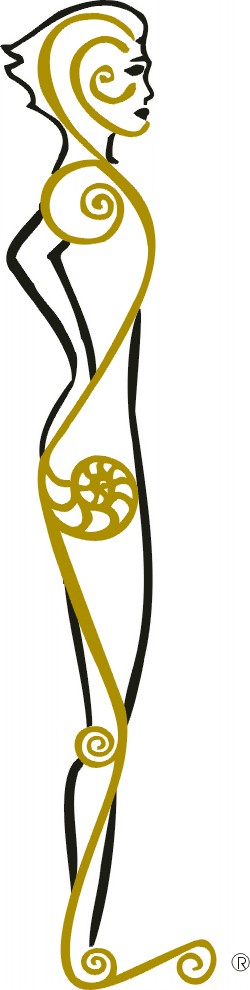
I drew the body’s dynamic as spirals joined tail to tail. Later, in a physics book, I found the same shape as the graph of a well-known equation: the Cornu Spiral, named for the French physicist Alfred Cornu. The name fit.
They are not the same thing. The Cornu Spiral is an equation with a fixed shape, used in designing roller coasters and highway curves. Cornu Tension is dynamic and has no equation yet. It is the living body reaching toward the ideal the spiral expresses.
The Cornu image appeared on the cover of The Elements of Pilates and the Michael Miller View in 2000, and it has been central to my work ever since.
Feel it in 30 words
The easiest place to find Cornu Tension is between the ears and the shoulders. Lying down, sitting, standing, or against a wall:
- Arms out, palms down, chin up.
- As you rotate your palms up, curl around your ears to look straight ahead.
- Pull your face away from an unwanted kiss.
- Arms down.
The third line matters most. It lines up the axis through the ears with the axes through the shoulders and the hips: three points on a line.
Who it is for
Pilates instructors, and anyone who teaches movement. Cornu Tension gives a teacher one idea in place of a long list of separate instructions, and a way to explain why the work works. It applies to every body, in any discipline.
Common questions
- Is Cornu Tension the same as Contrology?
- No. Contrology is Joseph Pilates’s method and the experience of doing it. Cornu Tension is my name for the uniform engagement the method calls for. It is the means, not the experience.
- Is it the same as torsion?
- No. Torsion is opposite rotation along a single axis. Cornu Tension is opposite rotation between axes.
- Is it the same as the Cornu Spiral?
- No. The spiral is Alfred Cornu’s equation. Cornu Tension is Michael Miller’s theory of biomechanics, and it borrows the name.
- Who discovered it?
- Michael Miller, an author and Pilates educator in Boulder, Colorado, who discovered and named Cornu Tension. The dynamic has always been in the body. He has taught Pilates since 1981, across the United States and in 13 countries.
Read more
- Dancing with Gravity: The Secret of Cornu Tension The full explanation of the method.
- Surviving Pilates Understanding the method, for students and teachers.
- The Elements of Pilates and the Michael Miller View Published in 2000. Where the Cornu image first appeared.